
Let´s imagine that a work Organization (soon to be client) has been sold on the idea and wants us to provide temporary workers under a temporary staffing agreement.
How would the process work in practice from beginning to end?
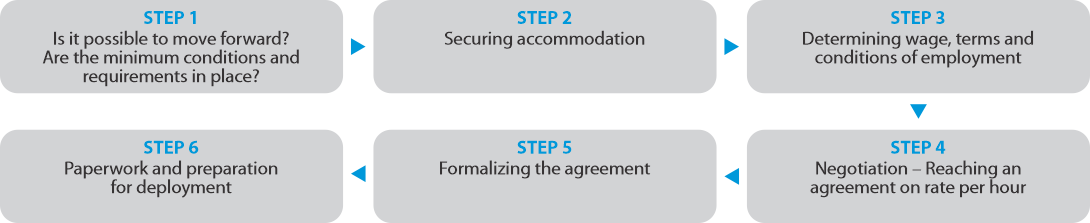
1 – First of all, one must ask, is it possible, given the specific nature, circumstances and general context of the request to legally assign workers to a determined work Organization, integrated in a specific sector of economic activity within a specific national jurisdiction?
a) Are the workers to be assigned, responding to permanent or specific, project based needs? Or are they to be assigned for needs that are temporary/specific in nature for a wide variety of reasons? If the manpower needs are unquestionably permanent in nature, it is not possible to move forward with any deal.
b) Is temporary agency work permissible in the case being considered? For example, in Germany, temporary agency work is not legal in the construction sector – period.
c) Does Work Supply meet the requirements to work in the jurisdiction where the workers will be posted?
Although our employment agency benefits from the fundamental freedom to conduct business in any EU member state (and, by extension, EEA member states as well) in the exact same way as any locally established company, some countries require pre-registration, pre-authorization or even requires that or permit or a license be obtained beforehand.
d) Does Work Supply have the ability to provide workers that meet potential client´s requirements? For example, if the client is looking for nurses, dentists, skyscraper cleaners, industrial air conditioning installers, etc we are unable to offer a solution since we do not provide workers or services of this nature.

2 – After establishing that all the requirements have been meet and no other legal or bureaucratic barriers exist, the second step is ascertaining that suitable accommodation is available to house the workers. Obviously, posted temporary workers need a place to stay.
If suitable and reasonably priced accommodation cannot be found, there is absolutely no possibility of moving forward.
3 – The third step in the process is figuring out how much the workers are to be paid. The EU Directive 2018/957 of the European Parliament and of the Council of 28 June 2018, states that posted workers are entitled to the terms and conditions of employment that are established in the host Member State apply insofar as they are more favourable.
That means it is not permissible to pay the posted workers a lower wage or salary or to provide them with less favourable employment conditions (overtime, weekend allowance, shift allowances, etc) than that which applies to those workers in the same job position and category directly employed by the Client.
For example, if a potential client in Austria pays its own entry level carpenters €16 per hour or €2,750 per month (gross), any workers posted to this Austrian client from another EU member state manpower provider, regardless of whether it´s Work Supply or any other foreign temporary work agency, cannot be paid less. The posted workers are also entitled to receive the same overtime, night shift allowance, food allowance, weekend pay bonus, etc that the Austrian company provides its own, directly employed carpenters.
However, what is stated above is only true, if the client in the EU member state to where the workers will be posted, provides its own workers with terms and conditions of employment that are in accordance with the law or any binding collective work agreement in force – these always take precedence.
In the example above, if a binding collective agreement exists in Austria stating that entry level carpenters must be paid €18 per hour or €3,095 per month – then this is what must be paid to carpenters posted to Austria to provide services to this client, along with any other benefits, allowances or extra pay mandated by the applicable Collective Labour Agreement.
EU directives clearly state that the End-user (client) in the EU (or EEA) member state is responsible for providing truthful information to the temporary work agency assigning the manpower. This effectively means that the end-user will be held accountable for any misrepresentations or non-conformities.

4 – The fourth step (negotiation) is quite simple and straightforward – an agreement must be reached concerning the rate.
At Work Supply our temporary agency work services are billed by the hour.
If 10 posted workers have each worked, for example, 40 hours in one week and we have agreed to a rate of €23 per hour, the client will be invoiced 10 workers x 40 hours x €23. Therefore, the client would be invoiced €9,200.00€ (VAT is not applicable).
It is important to note that the hourly rate we charge our clients is considerably higher than the hourly wage we pay our workers – unfortunately this is due to needing to cover overheads and our own staff wages, staff that process and facilitate all postings.
Other payroll costs such as paid vacations, Christmas and Holidays allowances, comprehensive work insurance coverage, mandatory employer social security contributions, mandatory employer contributions to the workers´ Compensation Fund, medical exams, dislocation expenses, etc. significantly add to the cost of our temporary staffing services.
The pleasant surprise is that, despite all these factors that can increase the rate we can offer, in most cases, the cost of our temporary staffing services is similar, and often lower, than the costs our European clientes have with workers they directly employ.
Upon request we can also send formal commercial proposals and quotes.
5 – The fifth step after an agreement has been reached regarding the hourly rate of our temporary staffing services and agreement has also been reached regarding accommodation, transportation, dates, timings, number of workers, requirements, logistics, etc., a formal temporary staffing agreement must be signed by both parties where everything that has been agreed to, is put in writing. The temporary staffing agreement is mandatory by law and, without it, Portuguese Social Security will not issue the necessary PDA1s. Also, we have observed that during audits or inspections officials will ask to see the temporary staffing agreement.
It is important to note that during this step, or at any time during the negotiation process, Work Supply – Trabalho Temporário Lda is more than happy to provide the client-to-be with any documentation upon request – licenses, surety or business bond, corporate certificate, any proof of registration, certificates of non-debt, samples of invoices or salary slips, identification documents of posted workers etc…
Transparency is our motto. It will help to build the vital trust between us and our clients.
6 – The sixth and final step involves all the preparatory paperwork and procedures that are needed to ensure that the posting is carried out to the highest standards and in accordance with Portuguese, EU and host country law, rules and regulations.

NO HASSLE, NO WORRIES!
Work Supply takes care of entire process, from A to Z.
It´s not by chance that our slogan is:
“WE OFFER PEACE OF MIND!